

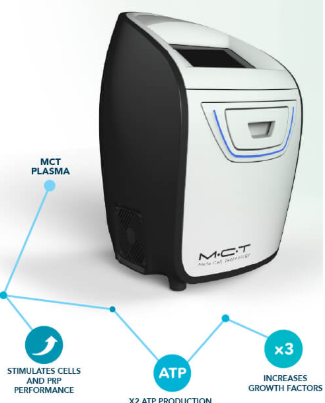
At Cosmedica Aesthetics, innovation is an important part of our commitment to helping clients achieve healthier, more youthful-looking skin. As aesthetic medicine continues to evolve, new technologies are creating opportunities to address common skin concerns with increasingly advanced, non-surgical treatment options. One of the technologies generating interest in the aesthetics industry is MCT Plasma Technology.
What Is MCT Plasma Technology?
MCT stands for Meta Cell Technology, an innovative system designed to enhance regenerative treatments using a patient’s own biological material. Rather than being a traditional plasma resurfacing treatment or plasma pen, MCT works with platelet-rich plasma (PRP) to support the body’s natural regenerative processes.
PRP has been used in aesthetic medicine for years. It is created by collecting a small sample of a patient’s blood and processing it to concentrate platelets within the plasma. Platelets contain naturally occurring growth factors and other biological components involved in tissue repair, cellular communication and regeneration.
MCT takes this established approach a step further through a process called photothermal biomodulation. By applying carefully controlled light and temperature to the prepared plasma, the technology aims to enhance platelet activity and encourage the release of growth factors and extracellular vesicles, including exosomes.
The goal is to create an enhanced regenerative preparation that can be incorporated into appropriate aesthetic treatment protocols.
This distinction is important. MCT does not simply replace conventional PRP; it introduces an additional processing stage intended to optimize the biological material before it is used.
How Does the MCT Process Work?
The MCT system combines two important components: photobiomodulation and thermal biomodulation.
1. Photo Biomodulation
Photo-biomodulation uses specific wavelengths of light to influence cellular activity. In the MCT system, controlled light exposure is used to stimulate the prepared biological material.
Light interacts with cellular structures involved in energy production and signaling. One area of interest is ATP (adenosine triphosphate), which serves as the primary energy currency of cells.
By supporting cellular energy production and platelet activity, photo-biomodulation is intended to improve the regenerative characteristics of the prepared plasma.
2. Thermal Biomodulation
Temperature also plays an important role in the MCT process. Carefully controlled thermal stimulation is used to condition platelets and influence their activation characteristics.
The objective is to encourage a more favourable growth-factor release profile while maintaining the biological properties of the patient’s own plasma.
Together, light and temperature create a controlled conditioning process designed to enhance the regenerative potential of conventional PRP.
The resulting MCT Plasma can then be incorporated into an individualized treatment approach, depending on the patient’s concerns and the practitioner’s assessment.
What Are the Potential Benefits of MCT Plasma?
Regenerative aesthetics is becoming an increasingly important part of modern skin health. Rather than focusing exclusively on temporarily correcting visible concerns, regenerative approaches explore ways to support the biological processes involved in maintaining healthy-looking skin.
Supporting collagen and skin quality
Collagen is an essential structural protein responsible for skin firmness, strength and elasticity. As we age, collagen production gradually declines, contributing to fine lines, changes in texture and reduced skin resilience.
Growth factors play important roles in tissue repair and cellular signaling. By enhancing the characteristics of PRP, MCT aims to support regenerative processes associated with healthier-looking skin.
Improving the appearance of aging skin
Fine lines, uneven texture, loss of radiance and changes in skin quality are common concerns among individuals experiencing natural aging and environmental damage.
MCT Plasma offers another avenue for exploring regenerative skin treatments, with early research examining its potential contribution to skin rejuvenation.
Supporting skin recovery
Regenerative treatments are also being explored as part of broader skin-recovery protocols. Depending on the treatment plan, practitioners may consider incorporating MCT Plasma into selected procedures to complement the body’s natural healing processes.
Exploring hair restoration applications
Another area of interest is scalp health and hair restoration. Since platelet-derived growth factors are involved in cellular signalling and tissue processes, researchers are exploring how enhanced autologous preparations may contribute to hair-related treatment protocols.
It is important to recognize that research into these applications is continuing. Individual outcomes vary, and MCT should not be presented as a guaranteed solution for hair loss, wrinkles or skin laxity.
MCT Plasma Versus Traditional PRP: What Is the Difference?
Traditional PRP and MCT Plasma share an important characteristic: both begin with the patient’s own blood.
The difference is in how the biological preparation is processed.
| Traditional PRP | MCT Plasma |
|---|---|
| Blood is collected and processed to concentrate platelets. | Blood is collected and processed to prepare platelet-rich plasma. |
| Uses conventional PRP preparation. | Adds controlled light and temperature conditioning. |
| Contains naturally occurring platelets and growth factors. | Aims to enhance platelet activity and growth-factor release. |
| Used in regenerative aesthetic protocols. | Designed to advance existing regenerative protocols. |
MCT is therefore an advancement in the preparation of autologous regenerative material rather than an entirely unrelated treatment.
Why Is Cosmedica Aesthetics Introducing MCT Technology?
At Cosmedica Aesthetics, we believe that the future of aesthetic medicine lies in combining proven treatments with emerging technologies that support skin health and natural-looking results.
Our decision to introduce MCT Plasma Technology reflects our interest in regenerative aesthetics and the growing demand for treatments that work with the body’s own biological processes.
We recognize that clients are becoming more educated about their treatment options. Many are looking beyond traditional cosmetic procedures and are interested in approaches that prioritize skin quality, collagen support and long-term skin health.
By incorporating MCT into our clinic, we aim to expand the regenerative treatment options available to our clientele while continuing to emphasize individualized care.
Our approach has always been about more than addressing a single cosmetic concern. We consider the overall condition of the skin, individual goals, lifestyle factors and appropriate treatment combinations when developing an aesthetic plan.
MCT represents an exciting opportunity to explore another dimension of regenerative medicine within our practice.
What Can You Expect When Exploring MCT at Cosmedica?
Introducing a new technology into an aesthetic clinic involves more than simply adding another treatment to the service menu. Education, appropriate protocols and individualized treatment planning are essential.
At Cosmedica Aesthetics, clients interested in MCT will have the opportunity to discuss their concerns and goals with our team. We believe that understanding the science behind a treatment is just as important as understanding the potential aesthetic outcomes.
Depending on the treatment protocol, MCT involves collecting a small blood sample, preparing the platelet-rich plasma and conditioning it using the MCT system. The resulting preparation can then be used according to the practitioner’s treatment plan.
Interested in learning more about MCT Plasma Technology?
Contact Cosmedica Aesthetics to learn about our upcoming introduction of MCT into the clinic and arrange a consultation.


